Showing posts with label Cheshire. Show all posts

Monday, 17 April 2017

Elizabeth Gaskell's Knutsford


Have you had a lovely Easter? We've had a relatively quiet one with lots of gentle pottering and catching up. On Saturday though, we headed out to the small town of Knutsford in Cheshire to follow the Elizabeth Gaskell trail. Officially it's called the Cranford Trail as she based many of the fictional characters on people and buildings in the town. I didn't watch Cranford but did love the mini-series, North and South, based on another of her novels (Richard Armitage - sigh!). Knutsford is a lovely place anyway, even if you're not a Gaskell fan and, last summer, we also did the town trail, following their 'Museum in the Street' signs. This post and photos are mostly the Gaskell/Cranford trail with a bit of the town trail mixed in - apologies in advance that it's pretty long as there's so much to see!


The starting point of the trail is Canute Place where there's a mosaic of King Canute. It's believed that Knutsford is named after him and is the place he built a ford - Canute's ford.


Walking down Canute Square to our next destination, you pass the 16th century White Bear which supposedly takes its name from an incident in 1617 when a bear was taken onto the pulpit of the Chapel of Ease in King Street (photo of that later). It also used to be the departure point of the stagecoach to London.


Heathwaite House, in Gaskell Avenue, was the childhood home of Elizabeth Gaskell. She was born in 1810 in London but her mother died only a year after her birth. She was sent to live with her mother's family, the Hollands, and brought up by her Aunt Lumb ('my more-than-mother').


The house overlooks the Heath, an area of common land. In Elizabeth's day it was the site of a racecourse.


Further along the street is Heath House which in Cranford was the home of the snobbish Mrs Jamieson. In real life, in the 18th century, it belonged to the notorious Edward 'Highwayman' Higgins.


Walking back to town we passed this row of pretty Georgian town houses. We loved the ironwork in the windows above the doors and the little balconies.
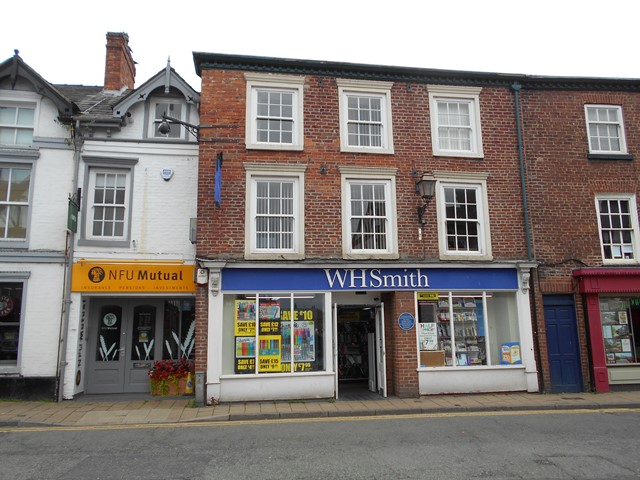

Back now in the town centre, we're walking along Princess Street which was the High Street in Cranford. Either the NFU or WHSmith building used to be a teashop ie a shop which sold tea.


At the end of Princess Street is the Old Town Hall, dating from 1871. It's recently been restored and opened as a restaurant and has some really beautiful brickwork.


A short walk away is the Sessions House. Built in 1818, the gaol which stood behind it once housed up to 700 prisoners.


Across the road is Hollingford House which was the home of Dr Peter Holland, Elizabeth's uncle.


Next door is St John the Baptist church where Elizabeth married William Gaskell in 1832. Although they were Unitarians, non-conformist chapels weren't allowed to hold weddings.


She wrote in her diary that the wedding was a happy occasion and most of the houses 'sanded' for the day (decorated the street with brightly coloured sand patterns). Sanding is still part of the Knutsford May Day celebrations.


We walked down the pretty cobbled street to King Street.


Walking to the right, number 15 was the home of Captain Henry Hill, a half pay officer who fought at Waterloo. He's thought to be the inspiration for Cranford's Captain Brown who was disapproved of because he spoke of being poor 'not behind closed curtains...but in the public street'!


There's a lovely row of 17th century whitewashed cottages at this end of the street.


Turning round and walking back towards the town centre, you pass the site of the former Chapel of Ease (mentioned earlier in the bear story) which was also a grammar school.


Over the Easter weekend though it was decorated with a bunny to show it as a site on the Bunny Hop trail. The whole town seemed to be out searching for bunnies that day!


There was also a lovely Victorian postbox outside. I read a fascinating article about old postboxes recently and all the different designs. Most of them have the ER logo for our current Queen but I've started looking out for the older ones now.


Next on the tour is Gaskell Tower, built in 1907 to commemorate the author.


On the side are engraved a list of her works. To be honest I think it's pretty ugly but, hey, I'd be happy to have a tower named after me!


This archway was the location of the Royal George Hotel.


Highwayman Higgins dined here and Queen Victoria visited in 1832. It also featured in both Cranford and Wives and Daughters as a place for dancing and playing cards.


On the opposite side of the road is the birthplace of Sir Henry Holland who was a doctor to Queen Victoria and Prince Albert amongst others and was also Elizabeth's cousin.


This building, currently a Chinese restaurant, was once a grocer and draper's.


Looking down King Street towards Tatton Park - marked by the burgundy sign in the distance.


A little further along is the entrance to a cafe which houses the  Penny Farthing Museum. The bikes hang from the ceiling and decorate the walls. The cafe is always incredibly busy and we've never yet been able to get a table.


Walking through the streets of Knutsford there are some lovely hidden corners including this one. The archway once led to the stables of an inn. The steps you can just make out behind the pink flowers were a mounting block.


My eye was also taken by this old bike with flower-filled baskets, outside an antiques shop.


Finally, at the end of King Street is this pretty blue and white house, the Old Vicarage. As well as featuring in Cranford as the home of the Matty family, it has also been the home of another famous female author. Alison Uttley, author of the Little Grey Rabbit books lived here in around 1910.


Just around the corner are the Ruskin Rooms completed in around 1902. The blue plaque notes that 'A Welcome Club for officers of the American Third Army was opened in this building by General George S Patton, Commanding Officer, on 25th April 1944 prior to the Liberation of Europe June 1944 to May 1945'. Look at the interesting chimney pots on the cottages next door too.


Beyond King Street is the entrance to Tatton Park which is mentioned as the home of the Cumnors in 'Wives and Daughters'. If you've read my blog a while, you'll know we visit Tatton often, though we usually enter by the main entrance at the other side of the park.

This point marked the end of the official trail. However, it seems more fitting to take you instead to a place we missed.


At the opposite end of town lies the Unitarian Brook Street Chapel. It is the oldest place of worship still in use in Knutsford and dates from around 1689. It was built at a time of great change in religious freedom so was built to look like a private house in case the right to worship here was withdrawn.


It is here, in a quiet corner of the small churchyard...


surrounded by her family...


that Elizabeth Gaskell was laid to rest in 1865.

I hope you enjoyed the tour. As you can see, Knutsford is a lovely place to visit with lots of historic buildings, independent shops and Tatton Park on its doorstep. Well worth a visit if you're in the area.

Enjoy what remains of the Easter weekend. Back to work for me tomorrow :( But I have a quilt workshop to look forward to next Saturday :) xx

Sunday, 15 May 2016

Clockwork garden


What a gorgeous weekend again! We're just back from a day out at a farmer's market at a historic house. However, I'm going to save that for another time as I still need to tell you about our day out last weekend.

Last Sunday Chickpea and I headed to Quarry Bank Mill near Styal in Cheshire. The Mill was built by the Greg family in 1784 and still houses working machinery. We weren't here to visit the mill this time though.


I'd read about the new Clockwork Garden exhibition which sounded just the kind of thing we like. It's been created by the House of Fairy Tales, a children's art charity, and tells the tale of mechanical creatures from Meccha_Donk who want to learn all about Earth and the evil Grizzlies who want to stop them. There are two parts to the exhibition, a trail around the garden and an indoor activity area.

First up, the Clockwork Garden Adventure trail. Follow us round to hear the tales and join in with the activities.


At each stage is a board with a part of the story, an activity and a clue to a word, or 'enchantment', to write on your map.

As you can see, the first enchantment tells of the salt road and there's a poem to recite.


Enchantment 2 is Brewer's Weeping Spruce which 'might look a little melancholy but is actually full of joyful magic from all the games and laughter and plays it has seen on this lawn'.

To keep its spirits high we had to tell it a joke, preferably garden-related. I'm rubbish at remembering jokes but Chickpea came up with this one: What do you call a budgie that's been run over by a lawnmower? Shredded tweet.

Groan. Moving swiftly on...


Enchantment 3 was at Troll Bridge where we had to wake the troll by chanting a rhyme:

'Goaty billy gruffy midge, wake up now and guard the bridge!'

It took us a couple of attempts as we a) had to wait until there was no-one nearby (we were still feeling a bit self-conscious at this point though that wore off...) and b) had to do it without laughing!


Enchantment 4 is the Owl-hermit's Cave. Some say a hermit used to live here and others that the Greg family kept owls. The task this time was to whisper a secret to the owl. Obviously, I can't tell you what we both said!


The terraced gardens were looking lovely and full of spring colour. I loved these candy stripe tulips.


Next, enchantment 5 and the Weir. We had to say a song (Fizz, bubble, mix, muddle...) and make our best bubbling sound.

Apparently the Gregs built lots of weirs to help mask the sound of the mill with the babbling of water.


Lovely views of the Greg's house as we climbed higher through the garden. The National Trust are opening it up to the public next year.


Enchantment 6, the Cliff Trees. To increase the strength and protection of the beech tree, stand in your bravest pose and tell the story of the bravest thing you've ever done.

Hmm, we struggled with this one. Maybe, that I've stopped killing spiders in the house and now catch them and put them outside, doing my best not to shriek when they move!


Enchantment 7, Stone Wall Messengers. Little creatures live in these walls and carry secret messages for the enchanted folk. We had to find one and whisper a word of encouragement. After a bit of searching I found an ant scurrying around, 'be brave, little one'.


We're nearing the top of the garden now with lovely views down the valley. Quite a different setting for a mill than the usual grime of the city.


Enchantment 8, the Tickling Roots. Deep underground live the Kobolds, or stone elves. Tickle them awake by stroking the roots of the beech tree from the trunk to the ground.


Enchantment 9, the Protector Tree. Inside the mass of shoots lives a group of tree gnomes. Use their language to ask the lime tree for help protecting Earth from the Grizzlies:

Smukt hoy arbro, behestle vil do yelber os? (Beautiful tall tree, please will you help us?).


Enchantment 10, the Great Beech. This ancient tree has seen many changes in its life. The Grizzlies are afraid of change. Help the tree show that there is nothing to fear from change by sharing something which has changed as you've grown older.

This was an easy one as both me and Chickpea chose to tell it about technology. When I first started work, my office shared one PC between six of us and there was no such thing as the internet (at least not the kind you'd recognise today).


As well as the enchantments, there were four sculptures to find known as tendrils. This was the turquoise tendril which is learning the joyful dance of the garden in the lively English winds. Twirl around like a leaf falling to earth and sway like a blade of grass.

The family picnicking nearby were definitely entertained by our twirling and swaying!


Enchantment 11, Four Trees. In this spot, Robert Greg built an observatory in the 1800s for his hobby of watching the stars. Stand in the centre of some trees and look to the skies.


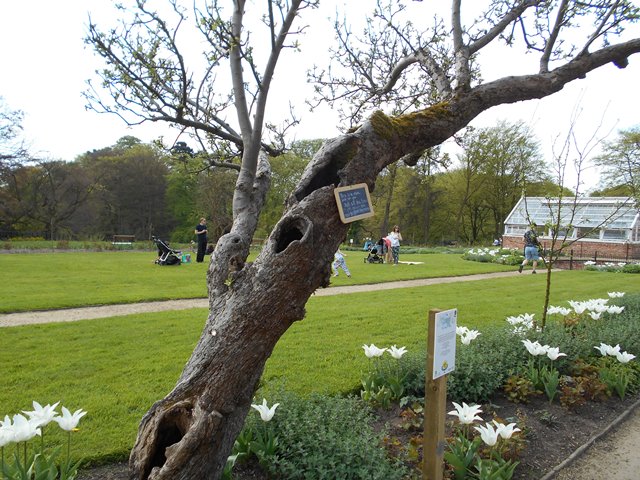
Enchantment 12, the Holey Tree. This apple tree is home to one of the mightiest of the Piskie wizards, RR. Her magic would be very helpful for stopping the Grizzlies. Find her name and ask for her help.

We had to look at all the labels on the tree to find that the Piskie is called Rosemary Russet.


Enchantment 13, the dipping pond. This was used by the gardeners to fill their watering cans. Create a sky poem by looking into the reflections in the water and saying three words for what you see.

My three words were clouds, fluffy, space.


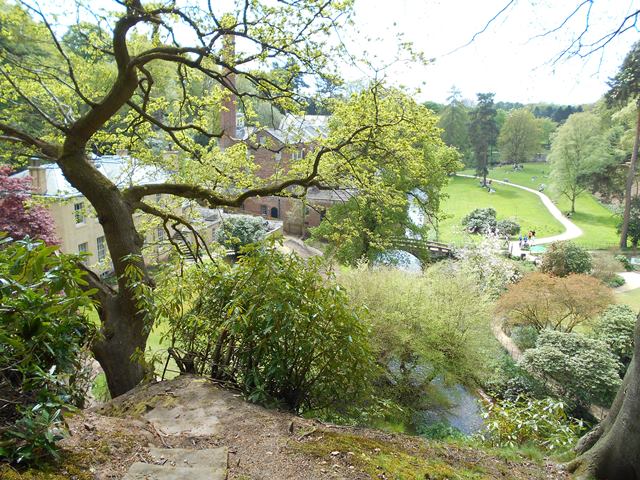
Enchantment 14, the View. Early in the morning the gardeners pause and look down the wakening valley. The sun shines ghost-lights through the rising mist which can trap and mislead an unwary traveller. What traps would you set for the Grizzlies?

Chickpea chose an impossible maze. I imagined paths of spiders' webs.


Also in the upper garden was another sculpture, the blue tendril, which is learning about the sounds of the garden. Close your eyes and listen: what is the smallest sound you can hear and what is the loudest?


Enchantment 15, the Nuttery. These are all young filbert (hazel) trees. The piskies love to eat nuts but can't break the hard shell. They have to team up with the nuthatch to break into the creamy flesh. Teamwork is great: high-five the person you're with!

This was the last of the clues in this part of the grounds so we wound our way back down the terraced garden.


Here in the formal garden was the third of the tendrils, orange, who is absorbing all the different fragrances of the garden. Investigate the smells around you: flowers, leaves, earth, stones, the air, the rain, the sunshine.


Time for a quick pitstop and to say hello to another visitor :) She's only 12 weeks old.


The final set of 'enchantments' are around the apprentice house where the boys and girls who worked in the mill were housed. We did have a tour but I'll save the photos of the inside for another time. Instead, let's head into the kitchen garden.


Enchantment 16, herbs for potions. The doctor used to use the herbs in the garden to make up medicines for the apprentices. One of these contained wormwood, borage and St John's....what? Find the name of the missing herb.

I knew this without looking: it's St John's Wort


At this point our journey went a little awry as the next enchantment we found was number 20, the compost heap. This dark, secluded corner is perfect for the Grizzlies to sneak into the gardens unnoticed. Make a home for a compost fairy so they can keep watch.

We didn't have time to do this as our allotted tour time was imminent. However, we did admire all the little structures made of clay, twigs and leaves which other people had made.


Here we also found the last of the sculptures, the purple tendril, reaching out to touch a tree, feeling its surface and texture. We had to find a plant nearby and do the same.


Enchantment 19, the Orchard. The inhabitants of planet Meccha_Donk eat only boring fuel cubes. In the orchard are all kinds of apple, pear and plum trees which give the Enchanted Folk and their spells special energy. We had to find our favourite tree name and say it aloud three times to thank the tree for making such special fruit:

'Peasgood's Nonsuch, Peasgood's Nonsuch, Peasgood's Nonsuch'

Peasgood's Nonsuch is an old variety of cooking apple.


Enchantment 18, the beehive. The Enchanted Folk love to spend time with the bees, admiring them for their endless energy and gentle nature. Say thank you to the bees and give them a cheerful wave.


Enchantment 17, dream flute. We may have gone out of order following the numbers in the trail but the story at this point made it the perfect place to end.

'Long ago an apprentice called Johnny Mitton worked extra hours in the mill...until he could buy a flute. He would come here after all the work and chores were finished and sit in the last of the sun to play sweet gentle tunes."

The task was to sing a gentle tune to fill the Grizzlies with positive magic. The first song which came to both me and Chickpea was 'The hanging tree' from the Hunger Games film - maybe not the most positive lyrics to end on but a beautiful and haunting tune.

This completed the trail and we collected a sticker as a reward :)


Next we headed into the mill to look at the exhibition. There was only one room but so much to see and do.


In this area you could make spirograph pictures. I used to have a spirograph as a child and haven't played with one in years. It was great fun to make patterns with all the coloured pens: I loved it!


I also had a go at making a paper flower which you then attached to ribbons hanging from floor to ceiling.

We had a brilliant day and I'd highly recommend a visit, particularly if you can take a child or two. We'll definitely be heading back to Quarry Bank over the summer as there was so much we didn't manage to see: the mill itself, the North and South woods, Styal village.

We've had another lovely day today and I'm off now to make dinner with the food we bought at the farmer's market. Then I'm hopefully going to catch up with your blogs. Enjoy the rest of your Sunday. x